
The Gig Economy Boom and How Freelancers Without Degrees Are Building Real Careers
Work no longer follows a single path. For decades, a college degree was seen as the default requirement for career success. Today, that assumption is quietly fading. As gig economy freelancing continues to grow, more people are earning well, working globally, and building long-term careers as freelancers without degrees.
Moreover, not everyone has the resources or opportunity to earn a traditional degree. Instead, many individuals focus on developing practical, job-ready skills through self-learning, experience, and online certification for freelancers, which helps polish their abilities and improve employability. This shift reflects broader gig economy trends, where outcomes matter more than academic backgrounds.
This article explores the gig economy boom and key gig economy trends, showing how freelancers without degrees build careers through online and offline courses, certifications, and real world experience. It highlights freelance skills in demand, top freelance jobs for non-graduates, and how freelance career growth through certifications supports those learning how to become a freelancer without a degree in a skills based hiring gig economy.
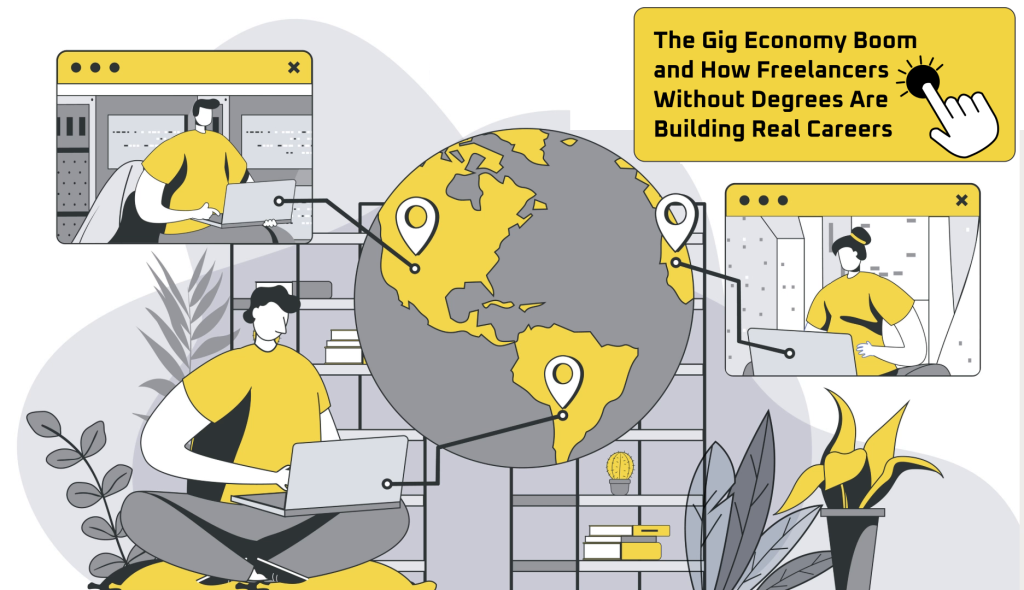
Understanding Gig Economy Freelancing
Gig economy freelancing is built around independent, project-based work. Freelancers offer specific services to clients for defined outcomes rather than committing to permanent roles. Many operate without formal education credentials, relying instead on practical ability and experience.
This model allows professionals to work with multiple clients, choose their projects, and grow careers on their own terms. It has become a central part of how modern businesses operate.
According to gig economy reports, there are an estimated 154 million to 435 million online gig workers worldwide, depending on how digital freelance participation is measured.
Why the Gig Economy Is Growing So Fast
The expansion of freelancing is not accidental. It reflects deeper changes in how organizations hire and how workers want to engage with work.
Skills Are Replacing Degrees in Hiring Decisions
Many employers no longer treat degrees as a requirement. Instead, they focus on what a freelancer can actually do. Can the person solve a problem, deliver results, and communicate clearly?
This is why employers increasingly hire freelancers without a formal degree. Proven skills and real experience often provide more confidence than academic background.
Remote Work Has Removed Traditional Barriers
Remote work has reshaped hiring completely. Companies can now work with freelancers across borders, time zones, and cultures. For freelancers without degrees, this means access to opportunities that were once restricted by geography or institutional credentials.
Talent is no longer filtered by location or education. It is filtered by capability.

Businesses Want Flexibility and Speed
Organizations today need quick solutions and specialized expertise. Hiring freelancers allows them to scale up or down without long-term commitments.
This demand for flexible, outcome-driven talent continues to fuel the gig economy boom, particularly in digital, creative, and technology-driven roles.
The Gig Economy Is No Longer a Side Option
Freelancing has moved well beyond the idea of side income. A growing share of the global workforce now participates in the gig economy in some form. Knowledge-based freelancers generate significant economic value and often earn incomes comparable to traditional employment.
For many professionals, freelancing is now a primary career choice rather than a backup plan.
High-Demand Freelance Skills That Do Not Require a Degree
Many of the most valuable freelance skills can be learned outside formal education systems.
Digital and Technical Skills
Web development, no-code tools, UI and UX design, automation, and AI workflow setup continue to attract strong demand.

Marketing and Growth Skills
SEO, content strategy, paid advertising, social media management, and performance tracking remain essential for businesses competing online.
Creative Skills
Graphic design, branding, video editing, animation, and multimedia content creation are consistently sought across industries.
Soft Skills That Matter More Than Expected
Clear communication, time management, adaptability, and problem-solving often determine whether a freelancer builds repeat clients or struggles to retain work.
According to Upwork’s Future Workforce Index Report, more than 28% of skilled knowledge workers in the U.S. now operate as freelancers or independent professionals, collectively generating $1.5 trillion in earnings in a single year.
Popular Freelance Roles for Non-Graduates
Some of the most accessible and scalable freelance careers include:
- Web developer or no-code specialist
- Graphic designer or video editor
- Digital marketer or SEO consultant
- UI UX designer
- Content writer or copywriter
- Virtual assistant or customer support specialist
- Automation and AI workflow consultant
These roles reward execution and results rather than academic credentials.
Why Formal Degrees Are Losing Their Influence
Learning is no longer limited to universities. Online courses, tutorials, communities, and hands-on practice allow people to reach professional skill levels faster than ever.
Clients care about outcomes. A working website, a successful campaign, or a well-designed brand asset carries more weight than a degree. This shift explains the rise of skills-based hiring throughout the gig economy.
How Freelancers Prove Their Skills Without Degrees
Freelancers who succeed understand that credibility must be demonstrated, not claimed.
Portfolios That Show Real Results
A strong portfolio often replaces a resume. Real projects, clear explanations, visuals, and measurable outcomes help clients understand exactly what a freelancer can deliver.

Strategic Use of Freelance Platforms
Platforms like Upwork and Fiverr allow freelancers to build visibility and credibility through reviews and consistent performance. Over time, reputation becomes a powerful differentiator.
Ongoing Learning and Skill Development
Freelancers who treat learning as a continuous process stay relevant longer. Tools and platforms evolve quickly, making regular skill updates essential.
Certifications That Add Structure and Trust
For freelancers without degrees, online certifications can strengthen credibility. Short, industry-aligned certifications reassure clients that skills have been independently evaluated.
Platforms such as ExpertRating offer globally recognized certifications across freelance-friendly domains, supporting long-term career growth without requiring formal education.
Why Certifications Matter to Clients
When clients compare proposals, visible skill validation helps reduce uncertainty. Certifications provide a standardized signal of competence and professionalism.
They help employers verify skills for freelancers they trust, especially when academic credentials are not part of the equation.
A Practical Example
Consider a freelance graphic designer who entered the market without a degree. By building a focused portfolio, earning a recognized certification, and consistently delivering quality work, they gradually attracted international clients and increased their rates.

For start-ups and small businesses, this approach often works better than traditional hiring. Results matter more than resumes.
Challenges Freelancers Should Plan For
Freelancing is not without risk. Competition can be intense, income may fluctuate, and benefits such as insurance or retirement plans are usually self-managed.
Successful freelancers plan ahead, manage finances carefully, and invest regularly in skill development. Staying relevant is an ongoing responsibility.
How to Become a Freelancer Without a Degree
Start by developing one strong skill rather than many average ones. Build a portfolio that clearly shows results. Use certifications to add credibility. Keep learning through practice and short courses. Network consistently and protect your professional reputation.
These steps matter far more than formal education in the freelance world.
Conclusion: The Future Is Skills-First
The gig economy boom confirms one thing clearly. Skills, performance, and proof of ability now outweigh formal degrees in many freelance careers. While education still matters in certain fields, the freelance economy rewards those who can deliver value consistently.
For aspiring freelancers without degrees, the path forward is practical and achievable. Build strong skills, validate them, showcase them effectively, and keep improving. The future of work belongs to those who can demonstrate what they can do, not just where they studied.